

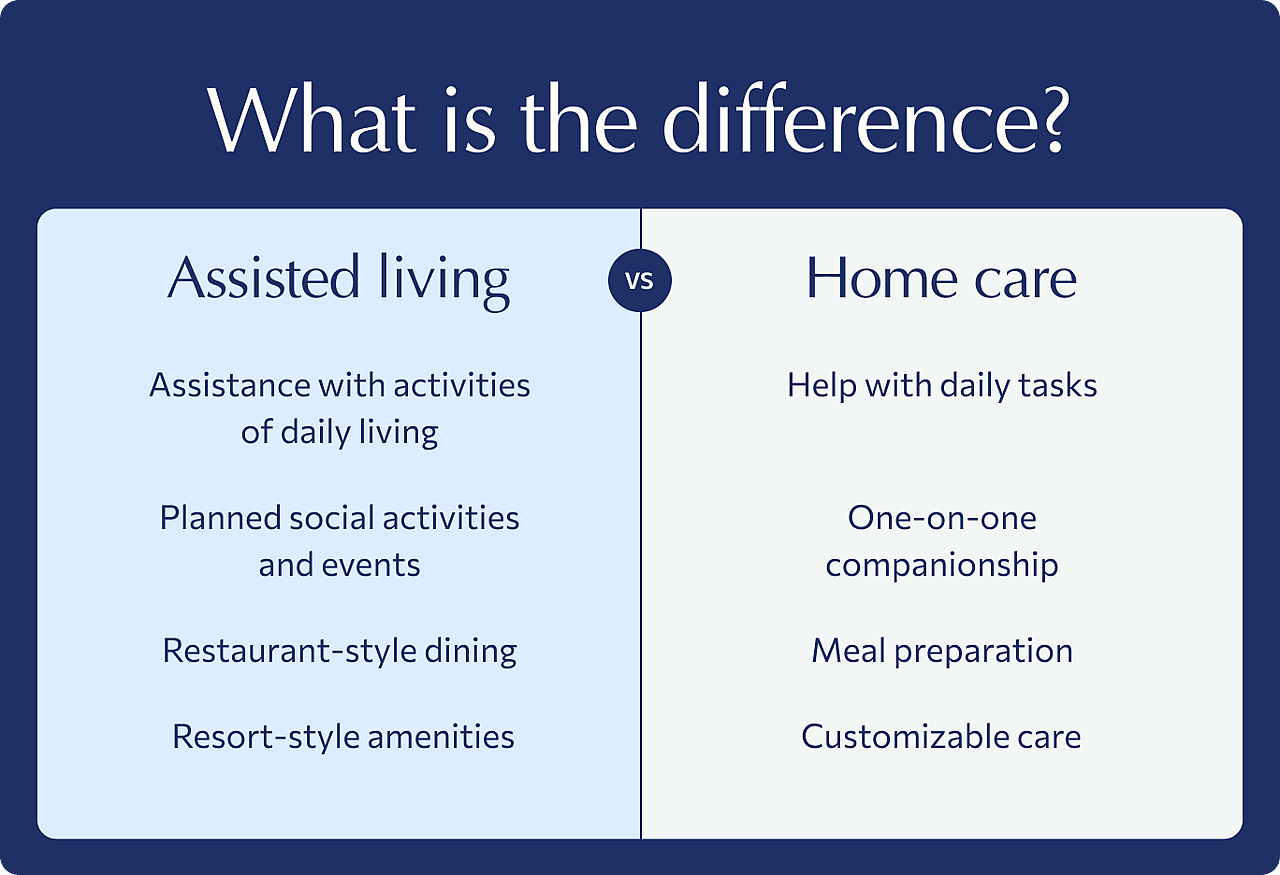
The primary difference between assisted living and home care is the setting, but there are other important differences. Both assisted living and home care help with activities of daily living, such as toileting, bathing, and dressing. Social opportunities and activities are also a feature of assisted living, but not typically part of home care. In an assisted living community, caregivers help multiple residents throughout the day while an in-home caregiver focuses on one person. The overall costs associated with each type of care vary greatly depending on how much assistance your loved one needs.
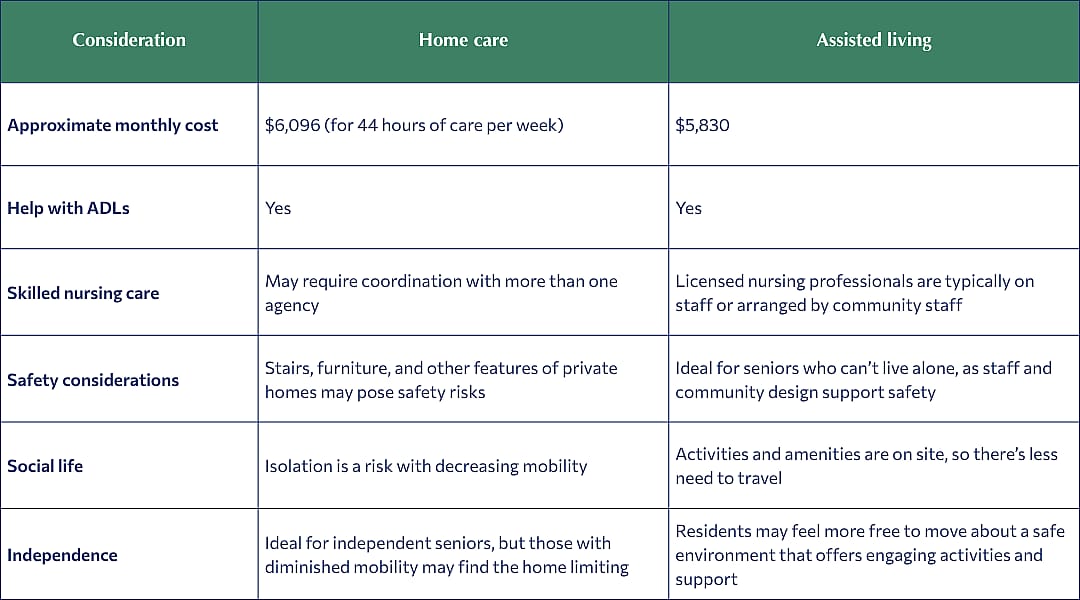
The average nationwide cost of assisted living is $5,830 per month, according to A Place for Mom’s proprietary cost data. In comparison, the national average cost of in-home care is $32 per hour. For full-time care at home, the cost is $6,096 per month, based on a schedule of 44 hours per week.
At a difference of more than $200 per month, finances play a role in choosing care. However, it’s important to consider what’s included with each type of care and how these costs are determined before deciding.
How are assisted living costs calculated?
Assisted living costs typically include care services, housing, and meals in one monthly fee. The monthly costs can vary greatly depending on factors like apartment size, state of residence, whether your senior loved one chooses to live with a roommate, and their required level of care.
What costs are associated with home care?
Just like with any market, in-home care prices depend on supply and demand. Costs for home care can vary greatly based on your location, the home care agency, staff salaries, and more. Remember that home health care is a little different, because it’s medical care ordered by a physician and may be covered by Medicare or private insurance if certain criteria are met.
Families and seniors considering home care should evaluate additional related costs, such as utilities, maintenance, repairs, and groceries. For an in-depth look at how the cost of home care would compare to assisted living costs in your area, try using a senior living cost calculator. You’ll be able to factor in common home expenses like utilities, groceries, and home maintenance when weighing your senior care options.
There are a variety of ways to pay for senior care for your loved one. It’s important to consider that each situation is unique and that not everyone will be eligible for the options presented below. Payment options include, but aren’t limited to:
Whether someone resides in an assisted living community or receives in-home care, they’ll typically receive the same level of care. In both settings, nurse’s aides and certified nursing assistants (CNAs) take vital signs, remind people to take their medication, and help with activities of daily living, such as bathing, dressing, and toileting.
Registered nurses (RNs) and licensed practical nurses (LPNs) do work in assisted living communities and do make house calls, but more intensive medical care is provided less frequently in these settings than in nursing homes, for example.
Professional caregivers in both assisted living and home care remind seniors to take their medication, but not all caregivers are permitted to administer medication. State laws vary, but in many states, only RNs and LPNs are allowed to give someone their medication.
Depending on the amount and type of support your loved one needs, assisted living may provide greater peace of mind because staff are available at all hours in case of emergency.
“There are aides on staff around the clock to assist with personal care needs,” says Michelle Aweshah, a regional manager at A Place for Mom. “Most communities also have nurses on site, as well as mobile services for physician appointments, therapy services, and more.”
Unlike home care, assisted living communities provide planned on- and off-site leisure activities as well as social activities, like happy hours and holiday celebrations, which are all very popular with residents. That said, professional in-home caregivers do provide companionship, and many will provide transportation to medical appointments and social outings.
Additional benefits of assisted living can include a host of helpful amenities and services:
“For many, being home may feel independent, but if they’re unable to drive, don’t visit friends as often anymore, or don’t eat as well, this can be very isolating and can lead to depression,” says Aweshah. “Being ‘independent’ can quickly become a detriment to quality and longevity of life.”
In an assisted living community, meals, social activities, and other amenities are available on site, so there’s less need to travel. Residents are free to engage in whatever activities interest them.
In a home care situation, family caregivers sometimes spend a fair amount of their time coordinating schedules. In assisted living, since staff are present daily and around the clock, family caregivers don’t need to ensure someone is available for their loved ones.
For seniors who need some daily assistance but remain independent and prefer to age at home, home care may be a good choice. However, if someone requires more than four or five hours of home care a day, assisted living may be the better choice financially.
“It’s a personal decision, and it can be difficult to reach out or ask for any type of assistance,” says Aweshah. “It’s always best to prepare yourself with the most information possible so you can make a choice that’s right for you and your loved one.”
This story was produced by A Place for Mom and reviewed and distributed by Stacker.


